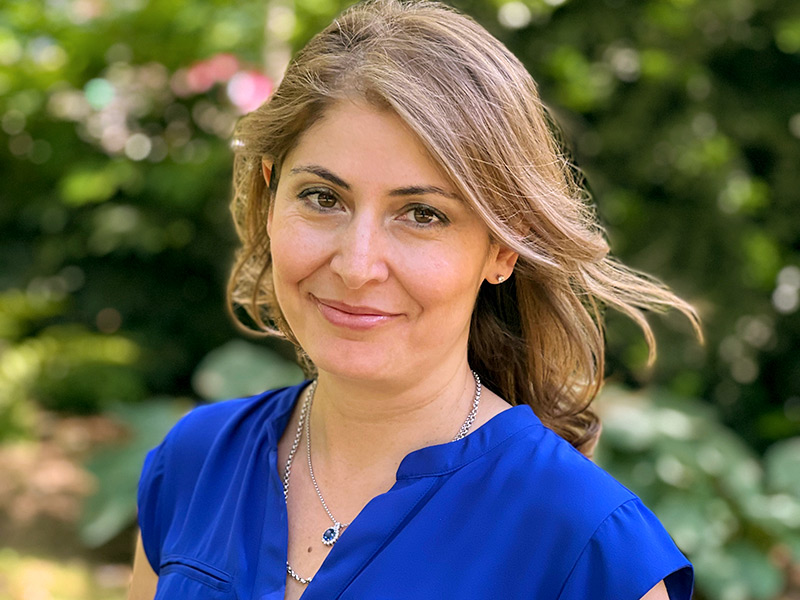
Headshot of Gulsah Akar

Gulsah Akar

Professor and Chair, School of City & Regional Planning

Contact

Telephone
Office
Architecture-East Building, 204-D

Gulsah Akar

Professor and Chair, School of City & Regional Planning

Specialization Area: 

Transportation

Biography:

Gulsah Akar is the Chair of the School of City and Regional Planning. Professor Akar conducts research on sustainable urban mobility. Her work led to various research projects and publications, from investigating built environment and travel connections using state of the art data collection technologies, to measuring access and equity, demographic differences in travel outcomes, and adoption of new mobility technologies. Her research received grant support from various sponsors including Ohio Department of Transportation (ODOT) and National Science Foundation (NSF). Professor Akar co-authored over 35 peer-reviewed articles in top-tier journals.

Akar joined Georgia Tech in 2021. Before joining Georgia Tech, she was a professor of City and Regional Planning at The Ohio State University (OSU). At OSU, she led the PhD Program of her unit from 2015 to 2021. She served as a Research Program Lead at OSU’s Sustainability Institute, providing direction for research on Smart and Resilient Communities across the university from 2019 to 2021. She was the Editor of Journal of Planning Literature from 2015 to 2021. She served as the Transportation Track Co-Chair of the Association of Collegiate Schools of Planning, and currently acts on multiple Transportation Research Board Committees.

Akar received her Ph.D. from the University of Maryland. She received her B.Sc. and M.Sc. degrees both from the Middle East Technical University, Ankara, Turkey.

Teaching Interest:

Professor Akar’s teaching interests include transportation planning, research methods, quantitative methods, and discrete choice analysis, with a focus on applying analytical tools to understand travel behavior and urban mobility outcomes.

Research Interest:

Professor Akar’s research focuses on sustainable urban mobility. She views mobility as fundamental to creating sustainable and resilient communities. Her work in this area encompasses a wide range of projects and publications, from examining built environment–travel relationships using state-of-the-art data collection technologies to measuring access, analyzing demographic and socioeconomic differences in transportation outcomes, and studying the adoption of emerging mobility technologies.

List of Recent Scholarly Work:

S.J. Lieu and G. Akar (2025) “Understanding rail users' mode choice behavior for first and last mile travel”, Journal of Transport Geography, Vol 125, https://doi.org/10.1016/j.jtrangeo.2025.104214

K. Kwon and G. Akar (2025) “Influence of neighborhood walkability on older adults’ walking trips: Does income matter?” Travel Behaviour and Society, Vol 38 https://doi.org/10.1016/j.tbs.2024.100912

S. Park and G. Akar (2024) “Analysis of socioeconomic and built environment factors influencing travel mode choice of older adults in Georgia”, Journal of Transport Geography, Vol 121. https://doi.org/10.1016/j.jtrangeo.2024.104030

B. Ozbilen, G Akar, K. White H. Dabelko-Schoeny, and Q. Cao (2024) “Analyzing the travel behavior of older adults: what are the determinants of sustainable mobility?” Ageing & Society 44 (9), 1964-1992 https://doi.org/10.1017/S0144686X22001180

J. Wang, E Dunham-Jones, G. Akar (2024) “Exploring the influence of driver’s presence on passengers’ willingness level to take autonomous taxis–Evidence from Seattle metropolitan area” Case Studies on Transport Policy, Vol. 16. https://doi.org/10.1016/j.cstp.2024.101212

K. Wang and G. Akar (2023) “Will Millennials Drive Less as the Economy Recovers: A Post Recession Analysis of Automobile Travel Patterns”, Journal of Planning Education and Research (JPER), Vl. 43, Issue 3 https://journals.sagepub.com/doi/10.1177/0739456X20911705

K. Kwon and G. Akar (2023) “What determines modal substitution between bike-sharing and public transit? Evidence from Columbus, Ohio during the COVID-19 pandemic, International Journal of Sustainable Transportation, Vol. 17, Issue 10, pp. 1087-1096 https://www.tandfonline.com/doi/full/10.1080/15568318.2023.2168576

B. Ozbilen and G. Akar (2023) “Designing pandemic resilient cities: Exploring the impacts of the built environment on infection risk perception and subjective well-being” Travel Behavior and Society, Vol 30, pp. 105-117 https://doi.org/10.1016/j.tbs.2022.08.013

K Wang, G Akar, L Cheng, K Lee, M Sanders (2022) “Investigating tools for evaluating service and improvement opportunities on bicycle routes in Ohio, United States”, Multimodal Transportation, Vol. 1, Issue 4. https://doi.org/10.1016/j.multra.2022.100040

Degrees with Year of Award:

Ph.D. 2009 Civil and Environmental Engineering, University of Maryland (UMD) at College Park
M.Sc. 2004 Civil Engineering, Middle East Technical University (METU), Ankara, Turkey
B.Sc. 2002 Civil Engineering, Middle East Technical University (METU), Ankara, Turkey