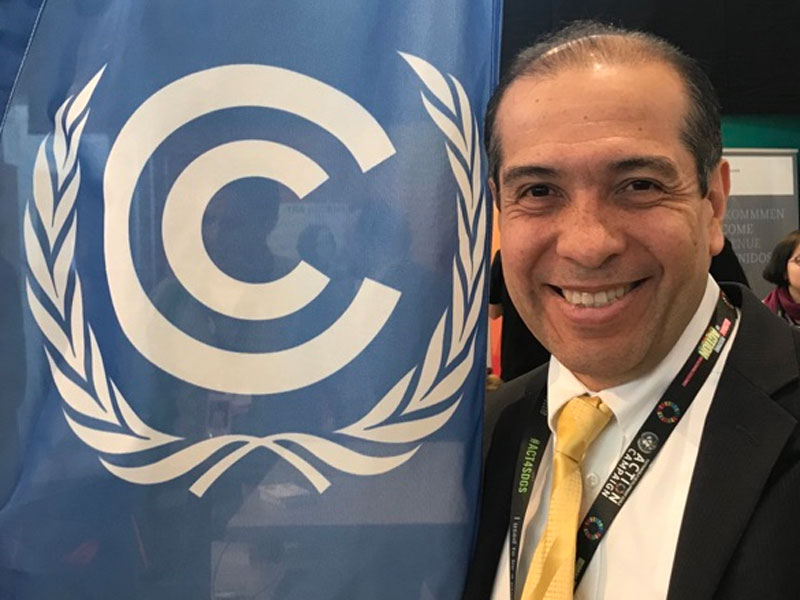
Jairo Garcia
Full-Time Lecturer, School of City & Regional Planning
Contact
Jairo Garcia
Full-Time Lecturer, School of City & Regional Planning
Specialization Area:
Environment and Health, Climate Change
Biography:
Dr. Jairo Garcia is an expert in sustainable urban development, carbon mitigation, and assessments of climate vulnerabilities and resiliency. Dr. Garcia's main area of research is focused on elements of spatial data analysis for ecological assessments and to identify climate vulnerabilities and climate risk analysis including public health and food systems.
As the former Director of Climate Policies and Renewables with the City of Atlanta, Dr. Garcia developed the first Climate Action Plan and led a coalition of stakeholders to craft the application for Rockefeller’s 100 Resilient Cities program, which the City of Atlanta was awarded in 2016. He represented the City of Atlanta at the COP23 Climate Summit of Local and Regional Leaders in Bonn, Germany, and participated as a U.S. Subject Matter Expert for the IPCC pre-scoping Special Report on Climate Change.
Dr. Garcia received the Individual Climate Leadership Award from the EPA in 2017, the Green Ring Award by Former Vice-President Al Gore’s Climate Reality Project in 2018, and the Excellence in Climate Leadership Award by the American Public Health Association Center for Climate, Health, and Equity in 2023 for his demonstrated an exceptional commitment to climate change research, communications, and activism.
Dr. Garcia holds an engineering degree, an MSc in Management of Information Technologies from Syracuse University, an MSc in Sustainability Management from Columbia University, and a Doctoral degree in Educational Technology and Sustainability from Pepperdine University. He has held research and academic positions with the Earth Institute at Columbia University, UCLA, and presently teaches classes at Georgia Tech in Sustainable Urban Development, Urban Planning, Global Cities, Sustainable Systems, and Climate Change Policies.
Teaching Interest:
My teaching interests center on sustainable urban development, climate policy, and environmental planning, shaped by my experience as both an educator and a sustainability practitioner for the City of Atlanta. I am committed to helping students understand the social, environmental, and economic dimensions of urban systems and to preparing future planners and policymakers to design equitable and resilient cities.
I am particularly drawn to teaching project-based, community-engaged courses, where students collaborate with real clients to address contemporary sustainability challenges. My studios and applied research courses have supported climate vulnerability assessments for cities and counties across Georgia and have been recognized by organizations such as UNITAR. I look forward to continuing to teach applied courses that give students hands-on experience with climate adaptation, mitigation planning, and sustainability analysis.
My teaching draws heavily on systems thinking, the UN Sustainable Development Goals, and the integration of data-driven tools such as GIS, remote sensing, and climate analytics. I also prioritize creating inclusive, student-centered classrooms that encourage collaboration, ethical reasoning, and engagement across disciplines. Beyond coursework, I am invested in mentoring students through research projects, internships, and applied studies.
Research Interest:
My research interests focus on the intersections of urban sustainability, climate vulnerability, and environmental policy, with a particular emphasis on developing analytical tools and community-centered strategies that help cities adapt to the accelerating impacts of climate change. Building on my professional experience with the City of Atlanta and my extensive applied research at Georgia Tech, I am committed to producing scholarship that supports equitable, data-driven decision-making in local and regional planning contexts.
A central theme of my research is the development of climate vulnerability assessments that integrate geospatial analysis, policy evaluation, and community engagement. I have led and co-authored climate vulnerability assessments for multiple jurisdictions—including Savannah, DeKalb County, Cobb County, Clayton County, Central Atlanta Progress, and Georgia Tech—which collectively examine heat exposure, flooding, infrastructure risk, social vulnerability, and greenhouse gas emissions. These projects, many conducted through studios or applied research collaborations, have been featured in national and international venues such as the UN Habitat Innovate4Cities Conference and the Global Climate Action Symposium. My research continues to explore how GIS, remote sensing, and emerging technologies such as AI can improve the precision and accessibility of local climate risk information.
Another major area of inquiry is urban climate governance, particularly the roles of local governments, regional agencies, and community organizations in shaping mitigation and adaptation policy. My work examines how cities operationalize climate goals through greenhouse gas inventories, resilience plans, sustainability metrics, and SDG-aligned reporting. Publications such as the City of Atlanta Climate Action Plan, multiple GHG inventories, and contributions to NOAA’s regional climate knowledge initiative reflect my interest in bridging scientific research with policy implementation and cross-sector collaboration.
I am also deeply interested in the socio-environmental dimensions of climate impacts, especially questions related to environmental justice, land use, urban heat, and ecosystem services. Several of my projects highlight the disproportionate burdens that climate risks place on vulnerable populations and underscore the need for planning strategies that integrate social equity with ecological resilience. Future research will continue to examine how policy frameworks, smart city technologies, and nature-based solutions can reduce these inequities.
Looking forward, I aim to expand my scholarship in three directions:
Advancing GIS- and AI-enhanced climate assessment tools to support more precise, scalable, and community-accessible urban resilience planning.
Evaluating climate governance mechanisms that strengthen local participation in national and international climate commitments, including the integration of subnational contributions to NDCs.
Developing interdisciplinary models of sustainable urban systems, drawing from circular economy principles, resilience metrics, and SDG monitoring frameworks.
Across all these areas, my goal is to produce research that not only advances academic knowledge but also provides actionable guidance to planners, policymakers, and communities striving for a more sustainable, equitable, and climate-resilient future.
List of Recent Scholarly Work:
PUBLICATIONS
• Garcia, J., et al. (2024). Georgia Tech Campus Vulnerability Assessment.
https://sustain.gatech.edu/resilience/
• Garcia, J., Easdale, A., Diefendorf, S., Kirkpatrick, K. (2023). Capturing Local Knowledge in the Southeastern United States. NOAA. https://www.scen-us.org/capturinglocalknowledge
• Garcia, J., et al. (2022). Climate Vulnerability Assessment Cobb County. https://urbanclimatenexus.com/gt-sustainable-cities-studio
• Garcia, J., et al. (2022). Climate Vulnerability Assessment Clayton County. https://urbanclimatenexus.com/gt-sustainable-cities-studio
• Garcia, J., et al. (2021). City of Atlanta Greenhouse Gas Emissions Inventory. https://sustainablecitiesc8.wixsite.com/ghgiatlanta
• Garcia, J., et al. (2021). Climate Vulnerability Assessment DeKalb County. https://cpcapstone2021.wixsite.com/dekalbcountycva
• Garcia, J., et al. (2020). Climate Vulnerability Assessment City of Savannah. https://cpcapstone2020.wixsite.com/mysite
• Garcia, J. et al. (2019). Climate Vulnerability Assessment Central Atlanta Progress. https://cpcapstone2019.wixsite.com/mysite
• Garcia, J., & D'Onofrio, D. (2018). A Multifaceted Approach to a Sustainable Transportation System: Reversing Transportation Trends in Atlanta, GA. In Performance Measurement in Local Sustainability Policy (Performance Measurement in Local Sustainability Policy ed., pp. 54-62). New York, NY: Routledge.
• Rudd, M.A., Moore, A.F.P., Garcia, J. et al. Climate research priorities for policy-makers, practitioners, and scientists in Georgia, USA. Environmental Management (2018). https://doi.org/10.1007/s00267-018-1051-4
• Buller, I.,…, Garcia, J. (2017). Assessing public health co-benefits of the City of Atlanta’s Climate Action Plan. DOI:10.13140/RG.2.2.31117.79845
• Garcia, J. (2017). Atlanta GRI Sustainability Report. https://issuu.com/atlantasustainability/docs/2015-2016-atlanta-gri-sustainabilit
• Garcia, J. (2015). City of Atlanta Climate Action Plan. https://atlantaclimateactionplan.wordpress.com/
• Davison, T., DeGise, J., Freund, P., Garcia, J., . . . Sarrinkolaou, G. (2012). At What Price? An Analysis of the Complex Market for Flood Insurance in New York City. Columbia University.
• Nugent, D., Rodriguez, L., & Garcia, J. (2012). New Approaches in Graduate Education for Sustainable Development: Modalities of Field Training in the Master’s in Development Practice Programs. In W. Leal, Sustainable Development at Universities: New Horizons. Frankfurt: Peter Lang Scientific Publishers.
• Garcia, J. (2010). Assessment of Education for Sustainable Development in Universities in Costa Rica: Implications for Latin America and the Caribbean http://eric.ed.gov/?id=ED514218
ACADEMIC PRESENTATIONS
• Georgia Resilience Conference Oct 20, 2025
o Resilience Plan Georgia Tech
o Climate Vulnerability Assessment Gwinnett County
• Georgia Planning Association Oct 9,2025
o Climate Vulnerability Assessments in GA
• UNFCCC Bonn Climate Conference Subsidiary Bodies (SB 62) Jun 16-27, 2025
o Subnational Participation in NDCs
• Hydrogen Energy Summit – Savannah, GA May 16, 2025
o Organizer, Moderator, Speaker – Hydrogen Energy in GA
• Georgia Tech Sustainability Showcase Feb 27, 2025
o Climate Vulnerabilities in GA
• Georgia Planning for Resilience Workshop Dec 2, 2024
o Heatwaves and Wildfires in GA
• UNFCC COP 29, Baku, Azerbaijan Nov 20, 2024
o Climate Vulnerabilities in the Southeast of USA
• National Academy of Sciences, Washington, D.C. July 16, 20204
o Climate Crossroad Summit
• UN Habitat Innovate 4 Cities Conference, Montreal, Canada Sep 13, 2024
o GIS and AI for Climate Vulnerabilities
• American Public Health Association Annual Meeting Nov 15, 2023
o Urban Heat & Public Health
• Association of Energy Engineers Annual Meeting Orlando, FL. Oct 26, 2023
o GIS for Climate Assessments
• Innovation and Entrepreneur Center, Medellin, Colombia Sep 23, 2023
o
Degrees with Year of Award:
Doctorate in Educational Technology and Sustainability 2010
Pepperdine University, Los Angeles, CA
Dissertation: “Assessment of Education for Sustainable Development in Universities in Costa Rica: Implications for Latin American and the Caribbean”
M.Sc. Sustainability Management 2012
Columbia University, New York, NY
Capstone Project: “Climate Resilience: At What Price? An Analysis of the Complex Market for Flood Insurance in New York City”
M.Sc. Telecommunications and Network Management 2001
Syracuse University, Syracuse, NY
B.Sc. Electronic Engineering and Telecommunications 1993
Universidad del Cauca, Popayán, Colombia